

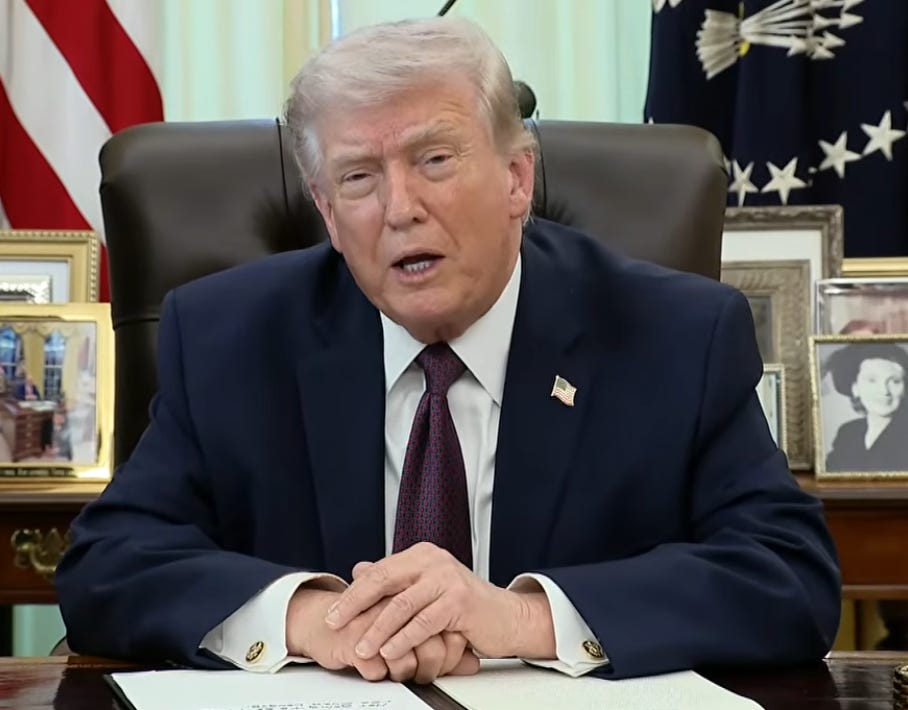
On March 31, 2026 President Donald J. Trump signed an executive order (EO) ENSURING CITIZENSHIP VERIFICATION AND INTEGRITY IN FEDERAL ELECTIONS. (Yes, the Administration used all caps.)
Here is the essence of what it orders:
“Federal statutes explicitly prohibit non-citizens from registering to vote or voting in Federal elections and impose criminal penalties for violations. (18 U.S.C. 241; 18 U.S.C. 611; 18 U.S.C. 1015; and 52 U.S.C. 20511).”
“To enhance election integrity via the United States Mail… [the federal government shall implement] “Secure ballot envelope identifiers provide a reliable, auditable mechanism to enforce Federal law without unduly burdening or infringing on the rights of eligible voters. Unique ballot envelope identifiers, such as bar codes, enable confirmation that only citizens receive and cast ballots, reducing the risk of fraud and protecting the integrity of Federal elections.”
“the Secretary of Homeland Security, through the Director of United States Citizenship and Immigration Services and in coordination with the Commissioner of SSA, shall take appropriate action to compile and transmit to the chief election official of each State a list of individuals confirmed to be United States citizens who will be above the age of 18 at the time of an upcoming Federal election and who maintain a residence in the subject State (State Citizenship List). The State Citizenship List shall be derived from Federal citizenship and naturalization records, SSA records, SAVE data, and other relevant Federal databases.”
“the Postmaster General is hereby directed to initiate a proposed rulemaking pursuant to 39 U.S.C. 401 and other applicable authority within 60 days of the date of this order. The notice of proposed rulemaking shall include, at minimum, the following… Proposed provisions specifying that the USPS shall not transmit mail-in or absentee ballots from any individual unless those individuals have been enrolled on a State-specific list.”
OK, got that? The DHS secretary will create a big list drawn from multiple federal databases, separate it into state-specific lists, then deliver it to the USPS and each state. And then the Post Office will police any election mail submitted.
Obviously, we Americans need a lot more details about how this plan would work, and congressional hearings should be held to explore this proposal.
Here are several of my own questions and thoughts:
By law the USPS is led by a board not the president. Can he order the agency to do any of this?
Relatedly, federal law and USPS regulations decide what the USPS can deliver. Does the Postman deliver live baby chickens (yes) or alcohol (no)? Well, the law and USPS regulations are determinative here. This executive order draws upon non-postal authorities (e.g., federal laws prohibiting non-citizens from voting in federal elections) and deploying the USPS as an enforcement mechanism. Is this legal?
This EO would create a DHS registry of where every American citizen lives and compel Americans to notify the government to update their data every time they move—lest they lose the right to vote by mail. I wonder how many Americans are comfortable with that.
All of this would appear to be administratively challenging. It requires the USPS to draw upon merged DHS/Social Security Administration data on what Americans live where to their own database, and to then police the mails to ensure nobody who is not on a state citizen list is casting a ballot. That means three different agencies have to have the same address information for a couple hundred million adult citizens. That’s a tall order, and the cost for an agency making a goof is that someone who wants to vote by mail and cannot due to a government good will have to petition the government to fix the problem.
The executive order's plan demands coordinated action by a few federal agencies and 50 state governments (and the District of Columbia). While not impossible, this is a tall order and will take a lot of leadership, time, and effort to execute. History is replete with agencies being told to coordinate and then failing to do so competently. Remember the intelligence and national security agencies’ failure to connect the dots prior to the 9-11 attacks?
This voter eligibility plan also presumes the federal government's data about an individual's state residency is current. That is a questionable assumption. When an individual moves he or she does not submit notification to the federal government identifying his or her new address. Hence, the Administration should explain whether Americans who move within six months or a year of an election will find themselves having to petition the federal government to change their state residency records and allow them to vote by mail.
Does the USPS have the information technology to do what the EO demands and can it get said technology running flawlessly in a short amount of time? I wonder. I regularly get mail delivered to my home that has someone else's name on it. When I check the USPS's online Informed Delivery system to see what mail is coming to me, the results sometimes are incomplete. That does not leave me comfortable in having them be the decider in whether I can, as I did last election, vote by mail.
This executive order does not provide either the Postal Service or the states with any funds to implement these new procedures. Congress would have to do that through the appropriations process and do it fast. The odds of that happening would appear to be very low.
Moving forward with this verification scheme also will directly overrule various states' elections policies. Colorado, for example, has universal voting by mail. I imagine many states will file suits. Should the federal government prevail, the states then will need to re-work their election administration very quickly, which can lead to gaffes this autumn.
I understand that the Administration feels that voting by mail is not particularly secure.
But even if one were to grant them that contention it does not follow that an executive order to fix this purported problem should be issued six months before voters are heading to the polls. Conservatives in particular recognize that government agencies often are klutzy and struggle to learn new tasks, and that it is difficult for them to execute inter-agency and inter-governmental coordination.
Team Trump could have done this a year ago while pursuing legislative enactment in parallel. They could pursue this action after this November’s election. But here we are, and my current sense is this executive order will face legal hurdles and loads of loud criticism from Democrats and quiet pushback from some Republicans.
I’m thrilled to share that the American Enterprise Institute has launched the First Branch Society, a bipartisan community of congressional staffers and experts dedicated to restoring Congress’s central place in the American constitutional system. Learn more at https://www.aei.org/policy-areas/legal-and-constitutional/first-branch-society/
And if you care about Congress, please sign up for the Understanding Congress newsletter. Surf here, scroll down, and add your email to the list.
A useful and thoughtful analysis, but perhaps missing some darker thoughts? For any previous administration I think it fair to attribute honorable intentions to such a task, but for this one other motivations need to be entertained. Democrats appear to vote by mail substantially more than Republicans. Is the goal to create an unworkable system so that large numbers of mail ballots are lost? Even more darkly, is the goal to deny voters an alternative to in-person voting in combination with intense, “immigration enforcement,” in critical districts, enforcement that we know can be based on accent and appearance, not citizenship status?
This is DOA